Warehouses that have spent heavily on automation are sometimes the ones with the most congestion problems. Not because automation fails, but because it gets placed where gravity would have done the job quietly and without complaint. Gravity roller conveyors keep appearing in high-performing logistics operations, not out of nostalgia, but because facility managers who have run both understand something spec sheets rarely capture: the absence of complexity is itself a form of reliability.
What Powered Systems Get Wrong
The default argument for powered belts is control — set the speed, move the goods, repeat. What that argument ignores is that control has a cost beyond electricity. Powered systems are tuned for one operating condition. When the product mix changes — heavier cartons one week, lighter parcels the next — the system does not adapt. Operators do, silently, by working around it every single day.
Gravity lines do not carry that burden. The load governs its own movement, which means the system responds to reality rather than imposing a fixed condition onto it. An unbalanced or poorly sealed box slows, wobbles, or stops—surfacing a problem before it becomes a picking error, a customer complaint, or a damaged goods write-off that nobody traces back to the conveyor.
The Reconfiguration Problem Nobody Mentions
Facilities change constantly. New suppliers bring different pallet configurations. Seasonal peaks shift flow direction entirely. Retail customers start demanding different unit quantities. Every one of these changes should prompt a layout review — and in powered-belt facilities, layout reviews are slow, disruptive, and routinely postponed because they involve electricians, downtime, and a budget conversation nobody wants to have.
Gravity roller conveyor sections can be lifted, repositioned, and reconnected within a single shift. There is no conduit to reroute, no motor to remount, no control panel to reconfigure. The practical consequence is that gravity-fed operations tend to stay current with how the business actually operates, rather than preserving a layout that made sense several years ago and has quietly become a workaround.
Gradient Design Is a Discipline
The most common failure in gravity conveyor installations is not mechanical — it is geometric. Facilities install gravity sections and then discover that goods either race towards the end stop uncontrollably or refuse to move at all, particularly when a heavier or lighter product is swapped in mid-run. This is not a product problem. It is an installation that was never properly specified for the actual load range.
Gradient design requires working out the relationship between roller diameter, roller spacing, surface material, and decline angle — calculated for the real product range, not a theoretical average. Facilities that do this upfront operate gravity lines that perform consistently. Those that do not inevitably add powered assist zones to compensate, which quietly defeats the entire rationale for choosing gravity in the first place.
Where Hybrid Layouts Win
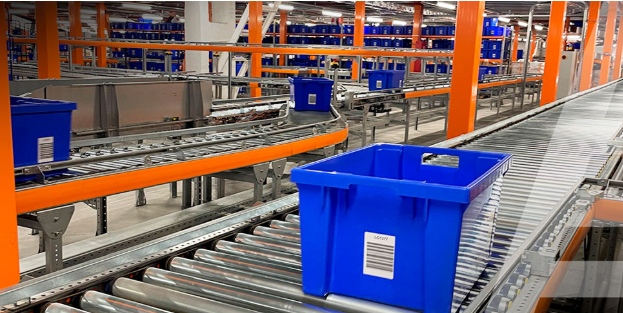
The most quietly effective warehouse layouts are neither fully automated nor fully manual. They are hybrid, and gravity roller conveyor sections are almost always the backbone of the manual-flow portions. Goods arrive at a powered in-duct, travel via gravity through the pick zone, accumulate at a gravity-fed despatch lane, and only interact with powered equipment when they genuinely need to change elevation or enter a sorting process.
This design philosophy concentrates maintenance in the areas where it is genuinely unavoidable and eliminates it in the zones where gravity is sufficient. When something does go wrong with a powered section, the rest of the operation keeps moving — because the gravity sections around it have no motor to seize, no belt to slip, and no sensor to misread.
Volume Surges Reveal the Truth
Peak trading periods expose what everyday operations conceal. Powered belts jam, overheat, and queue product in ways that require human intervention to clear — precisely when those humans are needed elsewhere. Gravity sections, under the same surge conditions, do not slow down. Heavier loads, moving in greater volume, actually travel more consistently along a calibrated decline than they do under normal throughput.
Conclusion
A gravity roller conveyor earns its place not by being impressive on paper, but by refusing to become a problem during the moments that matter most. The facilities running it well share one trait: they were designed for their actual product range, not a convenient average. That decision — unglamorous, detail-heavy, and easy to skip — is what separates a gravity system that performs from one that disappoints. The technology is not the variable. The thinking behind it always is.