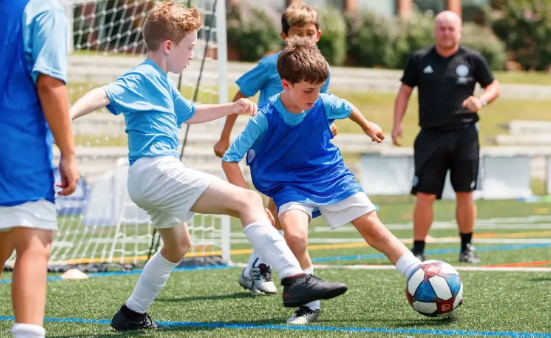
Most parents sign their child up for football, thinking about fresh air and weekend structure. What catches them off guard is everything else — the child who starts apologising unprompted, who handles a bad day at school without completely falling apart, who suddenly has strong opinions about effort and fairness. None of that appears on the registration form. A kids’ soccer club does not advertise these outcomes because they are genuinely difficult to measure. They just quietly happen, and the families who notice them are rarely surprised that they stayed as long as they did.
Failure Becomes Familiar
There is a particular kind of child who falls apart when things go wrong. Not because they are weak, but because nothing in their daily life has ever let them practise failure somewhere safe. Football changes that arrangement entirely. The missed shot, the error that costs a goal, the substitution that stings — these happen regularly, visibly, and within a group that reconvenes the following week, regardless of what happened. Over a season, children stop treating mistakes as emergencies. They start treating them as information about what needs work. That shift alone — from shame to curiosity — is one of the more underrated things organised sport quietly produces in young people.
Reading People, Not Just Plays
A kids’ soccer club creates a social environment that operates nothing like a classroom. No teacher is managing the dynamics, no structured turn-taking, no adult smoothing over friction before it becomes genuinely interesting. Children have to figure each other out in real time. Who responds well to encouragement. Who shuts down under criticism. Who needs space and who needs pushing through a difficult session. These are sophisticated social judgements. Most children do not learn them from instruction. They learn them from weeks of navigating a changing room where the emotional temperature is never quite the same twice.
What Movement Does to a Young Brain
The conversation around children and physical activity tends to stay frustratingly predictable — fitness, healthy habits, and less screen time. What gets skipped over is the more specific effect of sustained, purposeful exertion on a developing mind. Children who train consistently tend to show noticeably better emotional regulation. Not because sport teaches them to calm down in any deliberate sense, but because their nervous systems are being exercised alongside their bodies. Anxiety that has nowhere to go during a school day gets burned through on a pitch. The child who comes home from training exhausted is often the child who handles the rest of the evening far better than anyone expected.
The Value of Losing Together
A competitive kids’ football environment that never truly challenges its players is not preparing them for very much at all. The moments that lodge themselves in a child’s memory are rarely the wins. They are the losses that genuinely hurt, the matches where everything unravelled, and the experience of sitting inside that feeling alongside teammates who are equally gutted. Children learn something from collective defeat that individual setbacks simply cannot teach. That struggle shared is not weakness. It is the exact thing that turns a group of individuals into something that actually resembles a proper team over time.
Belonging Has a Lasting Effect
Not every child finds their place easily. School social groups are complicated, neighbourhoods shift, and confidence is inconsistent at that age for most children. A football club offers something more stable — the same people, the same shared purpose, the same pitch every week without fail. For children who feel slightly out of step elsewhere, that consistency becomes genuinely important to their sense of self. It is not just about friendship. It is about having somewhere that expects them to show up, notices when they do not, and treats their presence as something that genuinely matters to the group around them.
Conclusion
What a kids’ soccer club genuinely offers is not captured in any single training drill or match result. It lives in the accumulated experience of showing up week after week – through poor form, difficult teammates, and results that sting badly. Children who stay with a club long enough do not just improve at football. They become more socially fluent, more emotionally steady, and more comfortable with discomfort that the rest of life will ask of them endlessly. That is worth far more than any trophy ever will be.