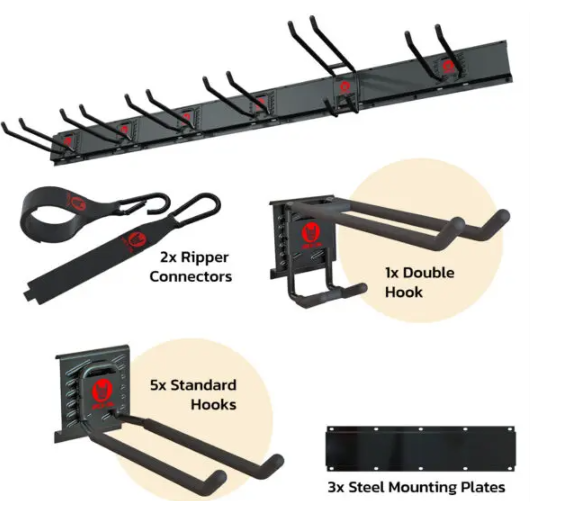
Ask any tradie or serious hobist what genuinely slows them down mid-project and the answer is rarely the task itself. It is the ten minutes spent hunting for a shifter that was definitely here yesterday. Disorganised storage is a productivity killer, and most people underestimate just how much cognitive load clutter creates before a single job even begins. A wall-mounted tool organizer solves a problem that drawer systems and toolboxes never quite manage — it puts everything in your line of sight, not buried under something else.
The Psychology of Visible Storage
There is research behind why open, visible storage genuinely improves how people work. When tools are out of sight — in drawers, boxes, bags — the brain still carries the mental weight of knowing they exist but not knowing exactly where. That low-level uncertainty is surprisingly draining. Wall-mounted systems eliminate it. You glance up, you see the spanner, you reach for it. The decision is instant. That might sound trivial until you realise how many times a day that micro-decision happens in an active workshop.
Why Pegboards Beat Toolboxes
Toolboxes have their place, but they are fundamentally designed for transport, not for active daily use. Opening drawers, sorting through layers, closing them again — it adds friction to every single interaction. A wall-mounted pegboard or slatwall panel puts your most-used tools at arm’s reach with zero barriers. The real advantage is not just speed either. When a tool is missing from its hook, you know immediately. That visual gap is something a toolbox drawer will never give you.
Moisture and Metal: a Quiet Problem
In Australian garages, especially coastal ones, humidity does real damage over time. Tools packed tightly together in a closed box trap moisture between metal surfaces — exactly the condition that accelerates rust and corrosion. A wall-mounted tool organizer keeps tools separated and exposed to air circulation. It is a passive protection most people never think about until they open a toolbox and find surface rust on a quality chisel they paid good money for. Spacing tools individually on a wall is one of the simplest ways to extend their lifespan without any extra effort.
The Hidden Cost of Clutter
Most people think clutter is a visual problem. It is actually a time problem. Studies on workplace organisation consistently show that the average person loses a meaningful chunk of productive time per week to disorganisation — hunting for items, reorganising piles, retracing steps. In a workshop setting that plays out as abandoned tasks, duplicated tool purchases because something could not be found, and jobs that take far longer than they should. Proper wall storage does not just look better. It quietly gives you time back.
Weight Matters More Than You Think
One thing that catches people off guard when installing wall storage is load capacity. Not all wall panels, hooks, or mounting systems are equal. A pegboard that handles screwdrivers comfortably might buckle under a heavy wrench set. Before buying, it is worth understanding the wall material — stud framing, masonry, or hollow cavity — and matching the mounting method accordingly. Heavy tools need to be anchored into studs or masonry plugs, not just drywall. Getting this wrong is the main reason wall organisers fail and put people off the idea entirely.
Zone Your Wall Like a Kitchen
The most functional wall storage setups are not just organised — they are zoned. Think about how a professional kitchen works: prep tools near the bench, cooking tools near the stove, plating gear near the pass. The same logic applies to a workshop. Cutting tools near the workbench, measuring and marking tools grouped together, power tool accessories near the charging station. Zoning means your hand moves to the right area instinctively, without thinking. That is not just tidiness — it is an ergonomic decision that changes the feel of every single job.
Renting? It Still Works
A common assumption is that wall storage means permanent holes and landlord headaches. That is less true than it used to be. Freestanding wall panel systems, heavy-duty freestanding frames with pegboard inserts, and French cleat systems that mount to a single batten rather than punching into multiple studs — these all offer genuine wall-storage function with far less commitment. Even renters with a modest garage or utility space can build a proper tool wall without risking the bond.
Conclusion
The difference between a frustrating workspace and a genuinely functional one often comes down to whether tools are visible or buried. A wall-mounted tool organizer is not just a tidying solution — it is a decision about how much friction you want between you and the work. Get the mounting right, zone it thoughtfully, and what looks like a simple storage upgrade quietly reshapes how the whole space performs.